
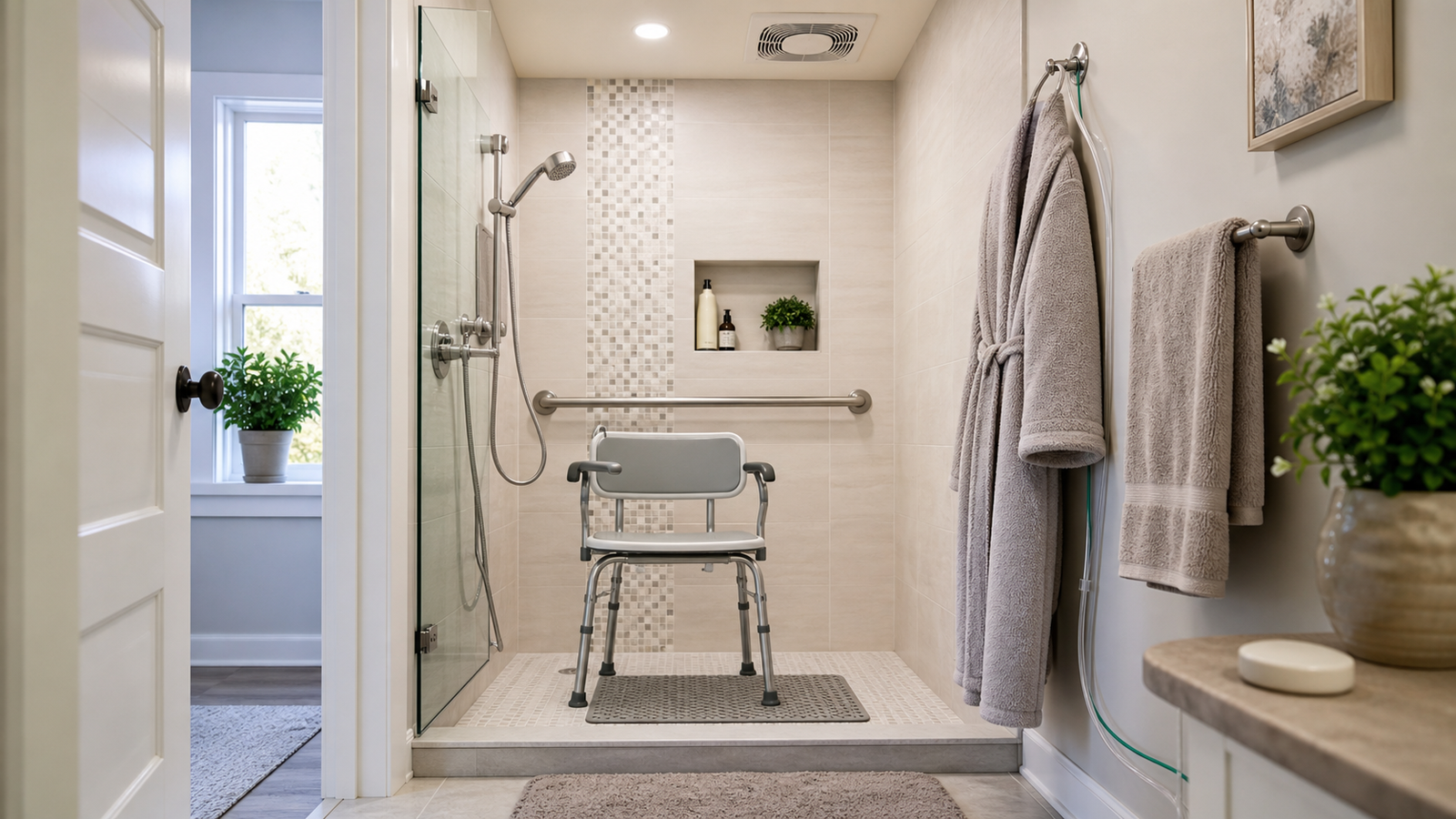
If you have COPD and the shower makes you feel like you just climbed a hill, you are not imagining it.
A shower can mix heat, steam, standing, bending, raised arms, slippery footing, and panic into one tight little room. For COPD lungs, that can feel brutal.
This guide is for education only. It does not replace your COPD action plan or your clinician’s advice. If your breathlessness is new, severe, or comes with chest pain, fainting, confusion, or blue lips, get urgent medical help.
Short Answer: Yes, Showering Can Feel Like Exercise When You Have COPD
Showering is not “just standing under water.”
It is a full-body task.
You may be:
- Standing in warm air
- Holding your arms up to wash your hair
- Bending to wash your legs or feet
- Turning in a tight space
- Rushing because you feel trapped
- Drying off with a towel after you are already tired
That is why many people with COPD feel short of breath during or after a shower.
COPD already makes airflow harder. The CDC says nearly 16 million U.S. adults have COPD, and many more may not know they have it 5. One of the common symptoms is shortness of breath during everyday activities 5.
And yes, showering counts as an everyday activity.
For some people, it counts as a hard one.
The 5 Big Reasons Showers Trigger Breathlessness
Here is the quick version.
| Shower Trigger | Why It Can Make Breathing Harder |
|---|---|
| Hot, steamy air | Heat and humidity can make the room feel harder to breathe in. |
| Standing still | Standing uses energy, especially if your legs are weak or tired. |
| Arms overhead | Washing hair can make the chest feel tight and raise your breathing effort. |
| Bending | Washing feet, shaving legs, or picking up soap can squeeze your breathing space. |
| Drying off | Towel drying is work. So is dressing right after. |
The fix is not “try harder.”
The fix is set up the shower so your lungs spend less energy.
When Shower Breathlessness Is Not “Just COPD”
Some breathlessness is common with COPD.
But not all breathlessness is safe to ignore.
Use this table as a guide.
| What Happens | What It May Mean | What To Do |
|---|---|---|
| You get mildly winded, then recover after sitting | Common exertional breathlessness | Stop, sit, use pursed-lip breathing, then continue slowly |
| Your oxygen level drops below your usual range | Possible exertional oxygen drop | Follow your oxygen plan. Tell your COPD care team if it keeps happening |
| You feel panicked but improve with sitting and slow breathing | Breathlessness-anxiety loop | Pause, cool the room, breathe out slowly, restart only if safe |
| You have chest pain, fainting, blue lips, confusion, or severe weakness | Possible emergency | Call emergency services |
| Your shower breathlessness is getting worse over days | Possible COPD flare, infection, heart issue, or oxygen-plan problem | Call your clinician |
| You cannot recover after the shower like you used to | Your daily activity tolerance may have changed | Ask about pulmonary rehab, oxygen testing, and medication review |
Do not change your oxygen flow on your own unless your clinician has already given you a clear plan for that exact situation.
A good question to ask is:
“For me, does showering count as exertion, and should I use a different oxygen setting during bathing?”
Why Showers Hit COPD Lungs So Hard
1. Hot steam can make the bathroom feel tight
A hot shower fills a small room with warm, moist air.
That can feel heavy.
For some people with COPD, steam can trigger coughing, chest tightness, or a suffocating feeling. COPD.net’s expert responses point to humidity plus the effort of washing as a common reason people feel short of breath in the shower 1.
This does not mean every person with COPD must avoid every bit of steam.
It means you should test what your lungs tolerate.
For many people, the sweet spot is:
- Warm water, not hot
- Bathroom fan on
- Door cracked open if safe
- Shower curtain or door slightly open to vent steam
2. Washing your hair is harder than it looks
Washing hair is sneaky.
You lift both arms.
You scrub.
You rinse.
You may hold your breath without noticing.
That arm position can make breathing feel tighter.
If hair washing wipes you out, split the task.
Try:
- Wash hair at the sink while seated
- Use dry shampoo on off days
- Ask for help if available
- Wash hair on a different day than your full shower
- Use a handheld shower head so you do not have to twist and reach
This is not laziness.
This is energy budgeting.
3. Bending can steal your breath
Bending forward to wash feet, shave legs, or grab dropped soap can make COPD breathing harder.
Why?
Because your belly and chest get compressed. Your breathing muscles have less room to move.
That is why long-handled tools matter.
Helpful options:
- Long-handled sponge
- Soap on a rope
- Shower caddy at waist height
- Pump bottle instead of a slippery bar of soap
- Seated foot washing outside the shower if safe
If you drop something, do not rush to grab it.
Stop.
Breathe.
Use a grabber or ask for help if needed.
A slippery shower is not the place to prove a point.
4. Drying off is part of the workout
Many people plan for the shower.
They forget the “after.”
But drying off can be the part that finishes you.
Big towels get heavy. Rubbing your back, legs, and feet takes effort. Then you still have to dress.
The COPD Foundation recommends energy-saving steps like using a shower chair, warm water instead of hot, a handheld shower, wearing prescribed oxygen in the shower, and using a terrycloth robe instead of towel drying 1.
The robe trick is simple:
- Step out carefully.
- Put on a thick terry robe.
- Sit down.
- Let the robe absorb the water.
- Dress later, in stages.
That one change can save a lot of breath.
5. Panic can join the cycle
This part matters.
You feel short of breath.
Your brain says, “I’m trapped.”
You start breathing faster.
Your chest feels tighter.
Now the shower feels dangerous.
That panic is real.
But it is not proof that you are failing.
It is your nervous system trying to protect you.
The move is to build a shower routine that makes panic less likely:
- Keep the door unlocked if you live with someone
- Keep a phone or alert device nearby
- Use a shower chair
- Keep the room cooler
- Turn off the water during breaks
- Practice pursed-lip breathing before you need it
The COPD Foundation teaches a simple stop-reset-continue method for shortness of breath: stop the activity, sit down, relax your shoulders, use pursed-lip breathing, then continue more slowly if you can 5.
That works well in the shower too.
The COPD Shower Plan: Before, During, and After
Think of this like a flight checklist.
Pilots do not “wing it.”
Neither should you.
Before You Turn On the Water
Set up the bathroom before you are tired.
Your pre-shower checklist
- Pick your best time of day.
Many people breathe better in the morning. Others do better later. Use your pattern. - Rest first.
Do not shower right after climbing stairs, cooking, cleaning, or rushing. - Lay out clothes.
Put underwear, socks, pants, shirt, and shoes where you can reach them. - Put supplies at waist height.
Soap, shampoo, razor, washcloth, and towel should not require bending. - Turn on the exhaust fan.
Start it before the water gets steamy. - Crack the door if safe.
This helps move humid air out. - Use warm water, not hot.
Hot water creates more steam and can wear you out faster. - Place a chair or bench correctly.
It should be stable before you step in. - Keep help within reach.
If you live alone, keep a phone or medical alert button close, but dry. - If prescribed oxygen, set it up before you start.
Use it exactly as directed.
The American Lung Association says people with COPD may need to plan bathing and showering for their best time of day and rest afterward 2.
That is not overplanning.
That is smart.
During the Shower
Your goal is not speed.
Your goal is control.
Try this rhythm
- Sit down.
- Get wet.
- Turn water off or aim it away.
- Soap one area.
- Pause.
- Breathe out slowly.
- Rinse.
- Repeat.
This is sometimes called a “Navy shower.”
It cuts steam and gives you breaks.
Use pursed-lip breathing
Try this:
- Breathe in through your nose for about 2 seconds
- Purse your lips like you are cooling soup
- Breathe out slowly for 4 to 6 seconds
- Keep shoulders loose
- Repeat until your breathing settles
Use it before you feel desperate.
Do not wait until you are gasping.
After the Shower
This is where many people crash.
So build recovery into the plan.
Your post-shower checklist
- Sit right away
- Put on a terry robe instead of rubbing hard with a towel
- Dry your feet while seated
- Dress in stages
- Rest before brushing teeth, shaving, doing hair, or leaving the house
- Track how long it takes to recover
If recovery takes longer than usual, write it down.
That is useful information for your clinician.
Can You Wear Oxygen in the Shower With COPD?
For many people, yes.
But the key phrase is: if it is prescribed and your care team says to use it that way.
COPD.net’s expert responses say people who depend on oxygen can usually wear it in the shower and route the tubing over the shower door, rod, or side of the tub 1.
The American Lung Association’s oxygen FAQ also says that if someone cannot tolerate being off oxygen and gets very short of breath or feels like they may pass out, they should not remove oxygen for the shower without guidance 3.
Basic oxygen shower safety
Use these guardrails:
- Keep the oxygen concentrator and electrical cords dry
- Keep the machine outside the shower area
- Do not let tubing loop around your feet
- Watch for tripping hazards
- Do not smoke near oxygen
- Keep oxygen away from candles, flames, or heat sources
- Ask your oxygen supplier how long your tubing can be
- Ask whether your device works best as continuous flow or pulse dose during showering
Do not guess your flow rate
Some people need more oxygen during activity.
But you should not decide that alone.
Ask:
“What oxygen setting should I use for showering, and what oxygen number is too low for me?”
Also ask:
“If my oxygen drops during a shower, when should I stop, when should I call you, and when should I call emergency services?”
That gives you a plan instead of panic.
Best Bathroom Upgrades for COPD, Ranked by Energy Saved
You do not need a luxury bathroom.
You need a safer one.
Start with the items that save the most breath.
| Upgrade | Why It Helps | Priority |
|---|---|---|
| Shower chair or bench | Cuts standing effort and lowers fall risk | High |
| Handheld shower head | Lets you rinse while seated | High |
| Grab bars | Gives support when stepping, turning, or pausing | High |
| Non-slip mat or strips | Reduces slipping risk | High |
| Exhaust fan | Moves steam out | High |
| Long-handled sponge | Reduces bending | Medium |
| Waist-height shower caddy | Keeps soap and shampoo easy to reach | Medium |
| Terry robe | Saves effort after the shower | Medium |
| Clear shower curtain | Can reduce the “trapped” feeling for some people | Optional |
| Battery fan outside splash range | Helps air movement, but must be used safely | Optional |
If you buy only one thing first, make it a stable shower chair.
If you buy two, add a handheld shower head.
That pair changes the whole task.
What If You Still Get Breathless After Every Shower?
If every shower leaves you wiped out, do not just push through.
Track it.
Shower symptom log
Write down:
- Time of day
- Shower length
- Water temperature
- Standing or seated
- Hair washed or not
- Oxygen used or not, if prescribed
- Oxygen level before and after, if you use a pulse oximeter
- Breathlessness score from 0 to 10
- Recovery time
- Any chest pain, dizziness, wheezing, or panic
Bring that log to your clinician.
It can help them spot patterns.
Maybe your oxygen plan needs review.
Maybe your inhaler timing needs discussion.
Maybe you need pulmonary rehab.
Maybe your shower setup is unsafe.
Do not guess.
Use the data.
Ask About Pulmonary Rehab
Pulmonary rehab is not just treadmill walking.
Good programs teach real-life skills.
That includes:
- Pacing
- Breathing during movement
- Energy conservation
- Safer ways to bathe, dress, cook, and climb stairs
- How to recover when breathlessness hits
The American Lung Association says daily activities like bathing, dressing, and grooming may be harder with COPD and recommends pacing, rest breaks, and pursed-lip breathing 2.
If showering is one of your hardest tasks, that is a fair reason to ask about rehab.
Say this:
“I am getting short of breath during showers. Can pulmonary rehab help me build a safer bathing routine?”
That is a normal, serious question.
The “Rescue Pause” If You Feel Trapped in the Shower
Print this.
Tape it near the bathroom if needed.
If breathlessness hits:
- Stop moving.
Do not keep scrubbing or rinsing. - Sit down if you can.
Use your shower chair or bench. - Turn the water cooler or off.
Less steam. Less noise. More control. - Open the curtain or door a little if safe.
Get air moving. - Drop your shoulders.
Tight shoulders make breathing feel worse. - Breathe out slowly through pursed lips.
Long, slow exhale. - Wait before standing.
Give your body a minute. - Call for help if you do not improve.
Especially if you have chest pain, faintness, confusion, blue lips, or severe weakness.
Do not rush out of the shower while dizzy.
A fall can turn a breathing problem into a bigger emergency.
Shower vs. Bath: Which Is Better With COPD?
It depends.
For many people with COPD, a shower is easier than climbing in and out of a tub.
But for others, a bath may feel calmer because there is less spray and less standing.
Here is the trade-off:
| Option | Possible Benefit | Possible Problem |
|---|---|---|
| Shower | Faster, less climbing if walk-in style, easier with chair | Steam, standing, slipping, panic |
| Bath | Less spray, can feel calming | Harder to get in and out, heat load, fall risk |
| Sponge bath | Low energy, can be done seated | May not feel as refreshing |
| Hair wash at sink | Splits the task | Still takes arm effort |
A PubMed-indexed study of 16 seated patients with severe COPD on home oxygen therapy found that movement during bathing could be linked with oxygen desaturation, and that posture, slow movements, and pursed-lip breathing instruction improved oxygen drops during bathing 9.
That supports what pulmonary rehab teams often teach:
Slow down.
Sit when you can.
Breathe on purpose.
Do not turn bathing into a race.
FAQ: COPD and Showering
Why do I get short of breath after a shower with COPD?
Because showering uses more energy than it seems.
Steam, heat, standing, bending, arm movement, towel drying, and dressing can all raise your breathing effort. COPD makes it harder to move air out of the lungs, so your body may feel short of breath during daily tasks.
Can hot showers make COPD worse?
Hot showers can make symptoms worse for some people.
The heat and steam may trigger coughing, chest tightness, or breathlessness. Try warm water instead of hot and keep the bathroom ventilated.
Is steam bad for COPD?
Steam is not “bad” for every person with COPD.
But many people find humid, steamy bathrooms harder to tolerate. If steam bothers you, use the fan, crack the door, lower the water temperature, and shorten the shower.
Can I wear oxygen in the shower?
If oxygen is prescribed, ask your clinician or oxygen supplier how to use it safely during bathing.
Many people can wear the cannula in the shower while keeping the machine and electrical parts dry. Tubing must be managed carefully so you do not trip.
Should I turn up my oxygen before showering?
Only if your clinician has told you to do that.
Do not change oxygen flow on your own. Ask whether showering counts as exertion in your oxygen plan.
Why does washing my hair make me breathless?
Washing hair raises your arms and uses shoulder and chest muscles.
That can make breathing feel tighter. Try washing hair separately, sitting down, using a handheld shower head, or asking for help.
What should I do if my oxygen drops after a shower?
Sit down. Use pursed-lip breathing. Use oxygen as prescribed.
If your oxygen level stays below your safe range, or you feel faint, confused, blue, or have chest pain, get urgent help. If the drop keeps happening, call your COPD care team.
How often should someone with severe COPD shower?
There is no one right number.
Some people shower daily. Others shower every other day and use sponge baths between. The safer goal is regular hygiene without exhausting yourself or risking a fall.
Ask your care team what makes sense for your COPD stage, oxygen needs, skin health, and home setup.
Can anxiety make shower breathlessness worse?
Yes.
Feeling trapped or afraid can make you breathe faster. That can increase chest tightness. A chair, cooler room, unlocked door, phone nearby, and rescue-pause plan can help.
Quick COPD Shower Checklist
Use this before your next shower.
Before
- Rest first
- Shower at your best time of day
- Turn on fan
- Use warm, not hot, water
- Set supplies at waist height
- Set up oxygen if prescribed
- Keep tubing away from feet
- Keep phone or alert device nearby
During
- Sit when possible
- Move slowly
- Use handheld shower head
- Pause between steps
- Use pursed-lip breathing
- Stop if dizzy, weak, or severely short of breath
After
- Sit right away
- Use terry robe
- Dress in stages
- Rest before the next task
- Log symptoms if showering keeps causing problems
Expert Review Card
Medical reviewer check before publishing:
[Reviewer Name], MD, FCCP should confirm:
- Oxygen safety wording
- Emergency red flags
- Advice on oxygen flow changes
- Pursed-lip breathing instructions
- Bath vs shower risk framing
- Any local emergency wording based on target country
Author experience note:
RRT should add one short field-tested tip from pulmonary rehab practice, such as:
“When I teach patients shower pacing, I treat drying and dressing as part of the shower. Most people forget that. The goal is not just to get clean. The goal is to get clean and still have enough breath left to recover.”
Sources
- CDC: COPD overview and U.S. prevalence 5
- American Lung Association: Conserving energy and daily activities with COPD 2
- COPD Foundation: Energy conservation tips for showering and oxygen use 1
- COPD Foundation: Pursed-lip breathing technique 5
- American Lung Association: Supplemental oxygen FAQ 3
- PubMed: Effects of bathing on lung mechanics in severe COPD 9
- COPD.net: Expert answers on showering with COPD 1