Last updated: July 30, 2026
Quick Answer: Why Does Getting Dressed Feel So Hard With COPD?
Getting dressed can feel like a workout with COPD because it stacks several breathing triggers at once.
You bend.
You reach.
You stand.
You twist.
You hold your breath without noticing.
Then tight clothing presses on your chest or belly.
That is a lot for lungs that already have to work harder.
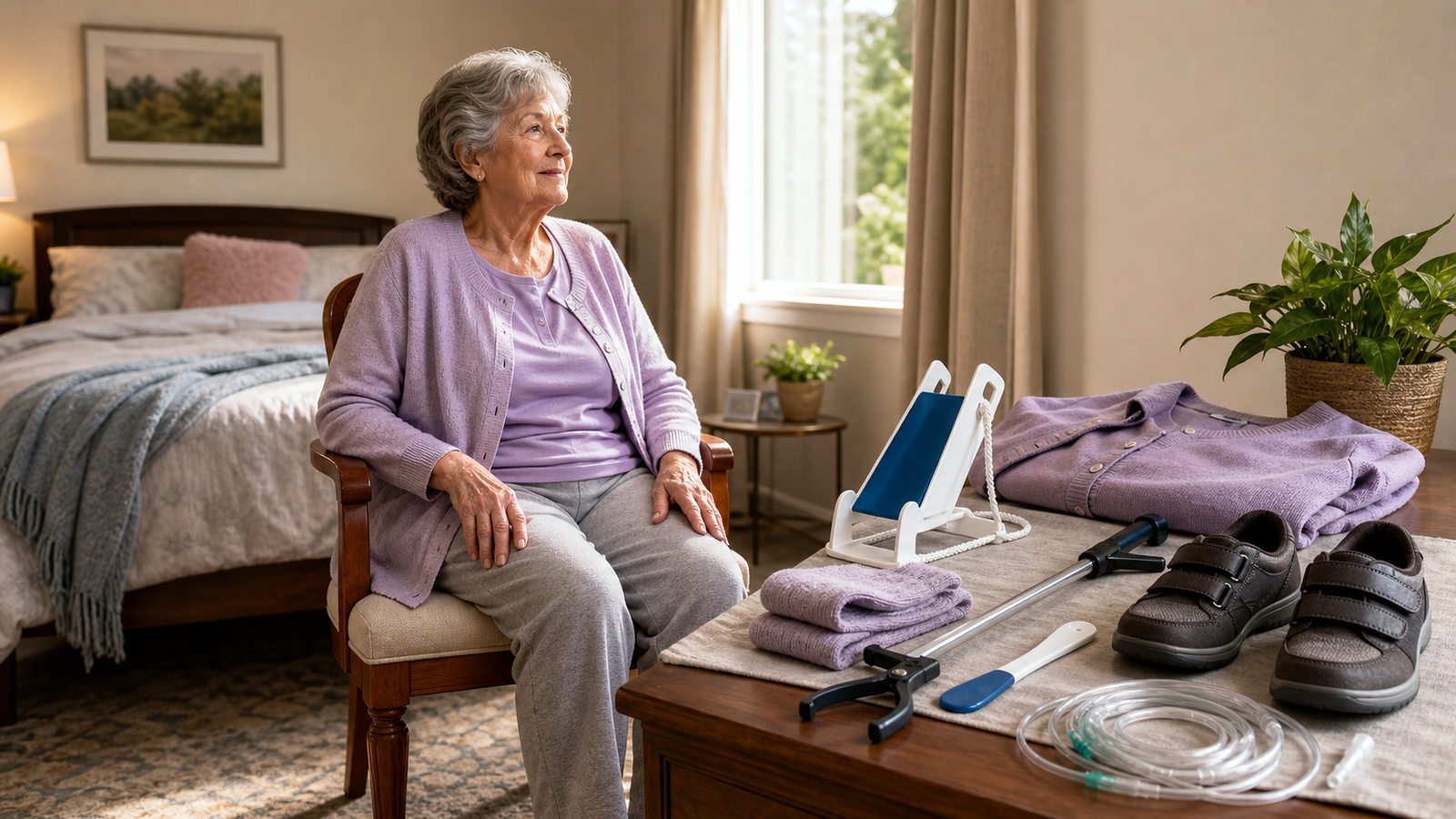
The American Lung Association lists dressing as an activity of daily living that can leave people with COPD tired or short of breath. It also recommends sitting down, pacing yourself, wearing loose or stretch clothing, using sock aids, reachers, long-handled shoehorns, and choosing slip-on or Velcro shoes 6.
So no, you are not lazy.
If socks, bras, and shoes wipe you out, your body is giving you useful information. The goal is not to “push through.” The goal is to dress in a way that saves air, saves energy, and keeps your dignity intact.
If You Are Winded Right Now, Do This First
Before reading more, pause.
- Sit down.
Use a firm chair if you can. - Drop your shoulders.
Tight shoulders make breathing feel worse. - Breathe in through your nose for about 2 counts.
Do not force a huge breath. - Breathe out slowly through pursed lips.
Like you are cooling hot soup. - Wait before standing.
Give your breathing a minute to catch up.
The American Lung Association teaches pursed-lip breathing as a way to slow breathing and help control shortness of breath. It also says to seek emergency help if shortness of breath continues 1.
Why Getting Dressed Can Hit So Hard With COPD
Dressing looks simple from the outside.
But for someone with COPD, it can be a full-body task.
You are not just “putting on clothes.” You are doing mini squats, balance work, arm lifts, trunk bends, and breath control.
That is why a calm morning can turn into sitting on the bed half-dressed, trying to get your air back.
Dressing Combines Too Many Jobs at Once
Think about what happens in five minutes:
- You bend to grab socks.
- You lift one leg.
- You hold your balance.
- You reach behind your back.
- You pull fabric over your head.
- You lean down for shoes.
- You tie laces.
- You stand up and walk away.
Each move costs energy.
With COPD, your breathing muscles may already be working harder before you even start. Add bending and reaching, and the “small task” gets big fast.
Bending Forward Can Trap Your Breath
Socks and shoes are often the worst part because they pull your body into a folded position.
When you bend at the waist, your belly pushes up. Your chest has less room to move. Your breathing can feel shallow, tight, or stuck.
That is why “just putting on socks” can feel like climbing stairs.
The fix is simple but powerful:
Bring the foot up. Do not bring your chest down.
Use a footstool, cross one ankle over the opposite knee if safe, or use a sock aid.
Reaching Overhead Can Steal Breathing Muscles
Shirts, bras, coats, and hair care often involve lifting your arms.
That matters.
Your neck, shoulder, chest, and upper back muscles help with both movement and breathing. When your arms are raised, those muscles are busy holding your arms up.
For some people with COPD, that makes breathing feel harder fast.
This is why front-opening tops, front-close bras, cardigans, robes, and zip hoodies can feel easier than tight pullovers.
Tight Clothes Can Make Your Chest Feel Boxed In
A tight waistband, bra band, belt, shapewear, stiff jeans, or high collar can make breathing feel restricted.
This is not “all in your head.”
If clothing presses around your ribs, belly, or upper chest, it can make each breath feel smaller. And when breathing already feels limited, even mild pressure can feel huge.
A COPD-friendly closet is not about giving up style.
It is about removing the clothes that fight your lungs.
Evidence Snapshot: Dressing Really Can Be Work
In one pulmonary rehab study, 31 people with COPD completed an activity test that included putting on socks, shoes, and a vest, plus stairs, dishes, groceries, towels, and vacuuming.
Before rehab, patients used about 54% to 79% of their peak aerobic capacity during daily activities. After an 8-week pulmonary rehab program, they used less ventilation and reported less breathlessness and fatigue during those tasks 3.
That is the proof many patients wish they had.
Getting dressed is not “nothing.”
For COPD lungs, it can be real exertion.
Is Being Breathless While Dressing a Sign COPD Is Getting Worse?
Sometimes dressing-related breathlessness happens because the task is awkward.
But a new change matters.
The mMRC breathlessness scale used in COPD includes a severe level where a person is “too breathless to leave the house” or “breathless when dressing or undressing” 8.
That does not mean every hard dressing day is an emergency.
It does mean you should not ignore a clear change.
Call Your Clinician If Dressing Is Suddenly Harder
Call your COPD care team if:
- Dressing is much harder than it was last week.
- You need more breaks than usual.
- You are using your rescue inhaler more often than your plan says.
- You feel breathless even after sitting and resting.
- You feel dizzy, weak, or unsafe while dressing.
- You are avoiding basic care because breathing feels too hard.
Do not wait until you are completely wiped out.
Small changes caught early are easier to manage.
Get Urgent Help Now If You Have Red Flags
Seek urgent care or call emergency services if you have:
- Chest pain or pressure
- Blue or gray lips, face, or fingernails
- Confusion
- Fainting
- Severe wheezing that does not ease
- Trouble speaking in full sentences
- New severe shortness of breath at rest
- Oxygen levels below your action plan range, if you have one
- Fever, shaking chills, or signs of infection with worse breathing
Do not drive yourself if you feel unsafe.
The COPD Dressing Rule: Sit, Set Up, Slow Down, Breathe Out
This is the whole strategy.
Sit. Set up. Slow down. Breathe out.
It sounds too simple.
It works because it removes the hidden work from getting dressed.
1. Sit Before You Start
Standing while dressing adds balance work.
Balance work costs energy.
Sit on a firm chair with a back. Keep both feet on the floor. If you sit on the bed, make sure it is not too soft or too high.
A chair near your closet or dresser is one of the cheapest COPD tools you can own.
2. Set Up Everything First
Before you start, place everything within easy reach:
- Underwear
- Pants
- Shirt
- Socks
- Shoes
- Bra or camisole
- Reacher
- Sock aid
- Long-handled shoehorn
- Oxygen tubing, if prescribed
- Rescue inhaler, if your plan says to keep it nearby
Do not make five trips across the room.
That turns dressing into a workout before the workout.
3. Slow Down Before Your Lungs Force You To
Most people rest too late.
They wait until they are already short of breath. Then recovery takes longer.
Try this instead:
- Put on one item.
- Pause.
- Take 2 or 3 slow breaths.
- Put on the next item.
You are not wasting time.
You are preventing the crash.
4. Breathe Out During the Hard Part
This is the part many people miss.
Do not hold your breath when pulling, bending, standing, or reaching.
Try this rhythm:
- Breathe in before the move.
- Breathe out while you pull, lift, stand, or reach.
Examples:
- Breathe in before sliding on pants.
- Breathe out as you pull them up.
- Breathe in before putting your foot into a shoe.
- Breathe out as you press your heel down.
- Breathe in before fastening a bra.
- Breathe out as your hands work.
Your breath should lead the movement.
Not chase it.
The Dressing Trigger Map
| Dressing Trigger | Why It Feels So Hard | Easier Fix |
|---|---|---|
| Bending for socks | Folds your body and limits chest room | Use a sock aid or footstool |
| Tying shoes | Forces bending and breath-holding | Use elastic laces, Velcro, or slip-ons |
| Bra band | Presses around ribs or upper belly | Try front-close, wireless, extender, or camisole |
| Pulling shirts overhead | Arms stay up too long | Choose front-opening tops |
| Tight waistband | Presses belly and ribs | Use stretch waist pants |
| Standing the whole time | Adds balance and leg work | Sit for most of the task |
| Rushing | Raises breathing rate and panic | Rest between clothing items |
Socks: Why They Can Wreck Your Breathing
Socks are sneaky.
They look tiny. But putting them on can force your body into one of the worst COPD positions: bent forward, arms reaching, belly compressed.
That is why socks can steal your breath before the day even starts.
The Problem Is Usually the Bend
If you bend straight down to your foot, you may notice:
- Tight chest
- Shallow breathing
- Fast breathing
- Panic feeling
- Lightheadedness
- A need to stop halfway through
That does not mean the sock is “too hard.”
It means the method is wrong for your lungs.
Try the Foot-Up Method
If your hips and balance allow it:
- Sit in a firm chair.
- Place one foot on a low footstool.
- Keep your back as upright as possible.
- Slide the sock on without folding your chest down.
- Pause before switching feet.
If crossing one ankle over the opposite knee feels safe, that can also help.
Do not use this method if it causes hip pain, dizziness, or balance trouble.
Use a Sock Aid Before You Think You “Need” One
A sock aid is not a defeat.
It is an independence tool.
It lets you load the sock onto a curved device, drop it to the floor, place your foot in, and pull the handles. Less bending. Less breath-holding. Less frustration.
The American Lung Association specifically recommends sock aids and other dressing tools to reduce bending for people with COPD 6.
Choose Socks That Do Not Fight You
Look for:
- Loose, non-binding tops
- Soft stretch fabric
- Easy-to-see heel pocket
- Smooth toe seam
- Fabric that slides on without a battle
Be careful with tight elastic bands.
If you use medical compression socks, ask your clinician how to put them on safely. Do not stop prescribed compression without medical guidance.
Bras, Bands, and Barrel Chest: How To Get Support Without Feeling Squeezed
This section matters because many COPD dressing articles barely touch it.
But real people talk about it.
A bra band can feel like a strap around the breathing muscles. By afternoon, what felt fine at 8 a.m. may feel like it is cutting into your air.
COPD.net published a lived-experience account from a woman with COPD who described barrel chest changes, bra bands worsening shortness of breath, and moving toward camisoles and looser tops after a clinician conversation 5.
That story is not every person’s story.
But it is a common enough problem that it deserves a practical plan.
Why Bras Can Feel Worse With COPD
A bra can cause trouble in a few ways:
- The band presses around the ribs.
- The clasp requires twisting or reaching.
- Straps dig into shoulders.
- High-compression styles press too firmly.
- Underwire can feel sharp or restrictive.
- Chest shape changes can make old sizing wrong.
Some people with COPD develop a more rounded chest shape over time. Not everyone does. But if your old bras suddenly feel wrong, the problem may not be weight gain or “being picky.”
The garment may no longer match your body.
The Band Should Support, Not Steal Your Breath
A bra should not make breathing feel harder.
If it does, test these changes:
- Go up one band size.
- Try a soft wireless style.
- Try a front-close bra.
- Use a bra extender.
- Try a camisole with gentle shelf support.
- Try a bralette with soft fabric.
- Save firmer support for short outings, not all day.
- Use loose layers at home if that feels better.
There is no moral prize for suffering through a tight band.
Comfort is a health tool.
Be Careful With High-Compression Sports Bras
Some sports bras feel great.
Others feel like a chest clamp.
If you try one, choose low or medium support first unless you truly need high support. Avoid anything that makes you take shallow breaths.
The best test is simple:
Put it on. Sit. Breathe normally for two minutes. Then walk across the room.
If your breathing changes fast, it is not the right daily bra.
COPD-Friendly Bra Options
| Option | Best For | Watch Out For |
|---|---|---|
| Front-close bra | Less twisting and reaching | Band still needs a good fit |
| Wireless bra | Less rib pressure | Some give less lift |
| Bra extender | Existing bra feels tight in band | Does not fix bad cup fit |
| Bralette | Soft daily comfort | Some roll up under breasts |
| Camisole with shelf support | Light support, less band pressure | May not support larger breasts |
| Loose layered tops | At-home comfort and privacy | Personal comfort varies |
| No bra at home | Maximum chest freedom | Your choice, your comfort |
A Simple Bra Test
Ask three questions:
- Can I take a slow breath without feeling blocked?
- Can I fasten it without twisting until I am winded?
- Can I wear it for two hours without wanting to rip it off?
If the answer is no, it is not your “daily COPD bra.”
Shoes: Stop Letting Laces Steal Your Air
Shoes are another classic trigger.
Not because shoes are heavy.
Because shoes make you bend, balance, reach, pull, and often hold your breath.
Laces are the worst part for many people.
Why Shoes Can Make You Breathless
Putting on shoes may involve:
- Bending at the waist
- Reaching both hands down
- Holding one leg up
- Pulling hard
- Tying knots
- Standing too quickly after bending
That is a lot of work for a task most people never think about.
Better Shoe Features for COPD
Look for shoes with:
- Velcro straps
- Elastic laces
- Wide openings
- Lightweight build
- Firm heel support
- Non-slip soles
- Room for swelling, if you have it
- A shape that works with a long-handled shoehorn
Slip-ons can help, but they must be safe.
Avoid loose slippers or backless shoes if you shuffle, feel dizzy, or have balance problems.
Easy should not mean risky.
COPD-Friendly Shoe Setup
Keep a shoe station near your chair:
- Shoes lined up
- Long-handled shoehorn nearby
- Socks within reach
- Footstool nearby
- Reacher nearby
- Good lighting
This tiny station can save several bends every morning.
The 7-Minute COPD-Friendly Dressing Routine
This is a sample routine.
Take longer if you need it.
The point is not speed. The point is control.
Minute 0–1: Sit and Reset
Sit in your dressing chair.
Drop your shoulders. Let your jaw relax. Take a few slow breaths.
If you use pursed-lip breathing, start now.
Do not begin dressing while already rushed.
Minute 1–2: Put Everything Within Reach
Lay your clothes in order:
- Underwear
- Pants
- Socks
- Bra, camisole, or undershirt
- Shirt
- Shoes
- Outer layer
Place tools nearby.
If you use oxygen, make sure the tubing is not wrapped around the chair leg, bedpost, or your feet.
Minute 2–4: Lower Body First
For many people, the lower body is the hardest part.
Start there while your energy is highest.
Try this order:
- Underwear
- Pants
- Socks
- Pause
- Shoes
Use the sock aid or footstool.
Do not bend all the way to the floor if you can avoid it.
Minute 4–5: Bra or Top
If bras are hard, use the easiest option for that day.
Not every day needs the same garment.
Try:
- Front-close bra
- Camisole
- Soft bralette
- Loose undershirt
- Button-front top
- Zip hoodie
- Open cardigan
If a shirt gets stuck over your head, stop.
Do not wrestle with fabric while holding your breath.
Minute 5–6: Shoes Without the Big Bend
Use your long-handled shoehorn.
If you have elastic laces, set them once so you do not tie them each time.
After both shoes are on, pause before standing.
Minute 6–7: Sit One More Minute
This last minute matters.
Many people stand up right after dressing, then feel wiped out walking to the bathroom or kitchen.
Sit. Breathe. Let your body settle.
Then stand slowly.
Should You Use Oxygen While Getting Dressed?
Follow your prescription.
Do not change oxygen flow on your own unless your written oxygen plan tells you to.
That said, here is a practical question to ask your care team:
“If I am prescribed oxygen during activity, does getting dressed count as activity for me?”
For many people, dressing is exertion. Your care team can tell you how your oxygen plan applies to showering, dressing, walking to the bathroom, and leaving the house.
Oxygen Tubing Safety While Dressing
If you use oxygen:
- Keep tubing in front of you where you can see it.
- Do not let it wrap around your feet.
- Watch chair legs.
- Keep tubing away from open flames.
- Do not tuck tubing under tight clothing.
- Sit before adjusting anything.
If tubing gets tangled, stop and fix it while seated.
Do not try to step through loops while breathless.
Inhalers, Mornings, and the “Why Is This Worse After Waking?” Problem
Many people with COPD feel worse in the morning.
Mucus, coughing, stiffness, poor sleep, and rushing can all pile up. The American Lung Association notes that morning cough, sputum, and shortness of breath are common challenges for people living with COPD 6.
That can make getting dressed feel harder before the day has even started.
Should You Use Your Inhaler Before Dressing?
Follow your exact medication plan.
Some inhalers are daily maintenance medicines. Some are rescue medicines. Some have timing rules.
Ask your clinician:
- “Should I dress before or after my morning inhaler?”
- “How long should I wait after using it?”
- “When should I use my rescue inhaler?”
- “What symptoms mean I should call you?”
- “Should I check oxygen during dressing?”
Do not guess with medication timing if mornings are rough.
Get a plan.
Closet Audit: Keep, Move, Replace
A COPD-friendly closet should reduce bending, reaching, pulling, and panic.
You do not need a new wardrobe.
Start by removing the repeat offenders.
Keep
Keep clothes that are:
- Soft
- Stretchy
- Loose around ribs and belly
- Easy to put on
- Easy to fasten
- Front-opening
- Light enough to layer
Good options include:
- Stretch waist pants
- Pull-on pants
- Button-front shirts
- Zip hoodies
- Cardigans
- Soft camisoles
- Loose socks
- Lightweight jackets
Move
Move daily items to the easiest spots.
Best height: between waist and chest.
Avoid making your daily clothes live:
- On the floor
- In low drawers
- On high shelves
- In deep bins
- Behind heavy closet doors
Put your most-used clothes where your hands naturally reach while seated.
Replace
Replace or retire items that make you breathless again and again:
- Tight jeans
- Stiff waistbands
- Tight bras
- High-compression tops
- Belts that dig in
- Tight sock bands
- Lace-up shoes you dread
- Heavy coats
- Tight collars
- Shapewear
If a garment keeps stealing your air, it is not “just clothing.”
It is a trigger.
COPD Closet Audit Table
| Keep | Move | Replace |
|---|---|---|
| Stretch pants | Daily clothes to waist height | Tight jeans |
| Front-open tops | Socks near dressing chair | Hard-to-fasten bras |
| Loose layers | Shoes near shoehorn | Tight belts |
| Velcro shoes | Laundry basket off the floor | Lace-up shoes |
| Soft camisoles | Reacher near closet | Tight sock bands |
| Lightweight jacket | Outerwear near exit | Heavy stiff coats |
Caregiver Tips: Help Without Taking Over
Getting dressed is personal.
For many people with COPD, needing help with clothing feels frustrating or embarrassing. The right help protects independence.
The wrong help makes a person feel handled.
Ask Before You Touch
Say:
- “Want help with the socks, or do you want the sock aid?”
- “Should I hand you the shoehorn?”
- “Do you want privacy while you do the bra?”
- “Want me to lay out clothes and step out?”
- “Do you need a minute before standing?”
Do not grab clothing, oxygen tubing, or a person’s body without asking unless there is an immediate safety issue.
Set Up the Room, Then Step Back
Useful caregiver help:
- Lay out clothes in order.
- Place shoes near the chair.
- Untangle oxygen tubing.
- Put the reacher nearby.
- Move laundry baskets off the floor.
- Check that the floor is dry.
- Give quiet time between steps.
The goal is not to dress the person faster.
The goal is to help them use less air.
Can Pulmonary Rehab Make Dressing Easier?
Yes, for many people.
Pulmonary rehab does not “fix” COPD. But it can train your body to handle daily tasks with less panic and better control.
And daily tasks are exactly where many people need help.
The pulmonary rehab study mentioned earlier used an 8-week program and tested real tasks: socks, shoes, vest, stairs, dishes, groceries, towels, and vacuuming. After rehab, people with COPD completed daily tasks in less time, with lower breathlessness and fatigue scores 3.
That matters.
Because the goal is not just a better test result.
The goal is being able to get dressed, leave the bedroom, and still have energy left.
Ask About ADL Training
ADL means “activities of daily living.”
Ask your care team if your rehab can include:
- Dressing practice
- Sock aid practice
- Shower pacing
- Stairs
- Carrying light items
- Oxygen tubing safety
- Getting in and out of chairs
- Upper-body strength
- Breath timing with movement
If your rehab only feels like treadmill time, speak up.
Tell them which real-life tasks are hardest.
FAQ: COPD and Getting Dressed
Why do I get short of breath putting on socks?
Usually, it is the bending.
When you fold forward, your belly and chest have less room to move. You may also hold your breath without realizing it.
Try sitting upright, using a footstool, or using a sock aid.
Why do shoes make COPD worse?
Shoes force bending, reaching, pulling, and balance.
Laces add more time in that bent position. Elastic laces, Velcro shoes, slip-ons with good support, and a long-handled shoehorn can help.
Why does my bra make me short of breath?
A tight bra band can press around the ribs and upper belly.
For someone with COPD, that pressure may feel much stronger than it looks. Try a front-close bra, wireless bra, extender, soft bralette, or camisole.
Are sports bras good for COPD?
Sometimes.
Low or medium support sports bras may feel comfortable. High-compression sports bras may feel too tight and make breathing feel restricted.
Test any bra while sitting and walking indoors before wearing it for a full day.
Does being breathless while dressing mean end-stage COPD?
Not automatically.
But breathlessness with dressing is a serious symptom marker in common COPD breathlessness scoring. If this is new, worse, or paired with red flags, call your clinician 8.
What is the best dressing aid for COPD?
For many people, the best starter tools are:
- Firm chair
- Sock aid
- Long-handled shoehorn
- Reacher
- Elastic laces
- Footstool
Start with the task you hate most.
If socks are the problem, start with a sock aid. If shoes are the problem, start with elastic laces and a shoehorn.
Should I get dressed sitting down?
Yes, if standing makes you tired or breathless.
The American Lung Association recommends sitting on a bed or chair to get dressed and resting between clothing items 6.
A chair can also lower fall risk.
What clothes are best for COPD?
Look for clothes that are easy to put on and do not squeeze your ribs or belly.
Good choices include:
- Stretch waist pants
- Loose tops
- Front-opening shirts
- Cardigans
- Soft bras or camisoles
- Non-binding socks
- Lightweight layers
- Slip-on or Velcro shoes
Are compression socks safe with COPD?
They may be safe if they are prescribed or cleared by your clinician.
But compression socks can be hard to put on and may require extra effort. Ask about donning aids or easier options if you need them.
Do not stop prescribed compression socks without asking your care team.
Why is dressing worse in the morning?
Morning symptoms are common for many people with COPD.
Cough, mucus, stiffness, poor sleep, and rushing can make the first hour harder. Try laying out clothes the night before and giving yourself more time.
Should I rest after getting dressed?
Yes.
A one-minute rest after dressing can prevent the “I got dressed and now I’m done for the day” crash.
Sit. Breathe. Then stand.
Bottom Line: You Are Not Lazy. The Task Is Too Expensive.
Getting dressed with COPD can feel hard because the task is packed with hidden effort.
Socks make you bend.
Bras can squeeze.
Shoes make you reach and balance.
Tight clothes fight your breathing.
Rushing makes all of it worse.
The fix is not to shame yourself.
The fix is to change the setup.
Sit down. Put everything close. Use tools early. Choose clothes that work with your lungs. Rest before you crash. Ask pulmonary rehab to train the tasks that actually matter in your life.
Getting dressed should not take your whole day’s energy.
And with the right plan, it may not have to.