
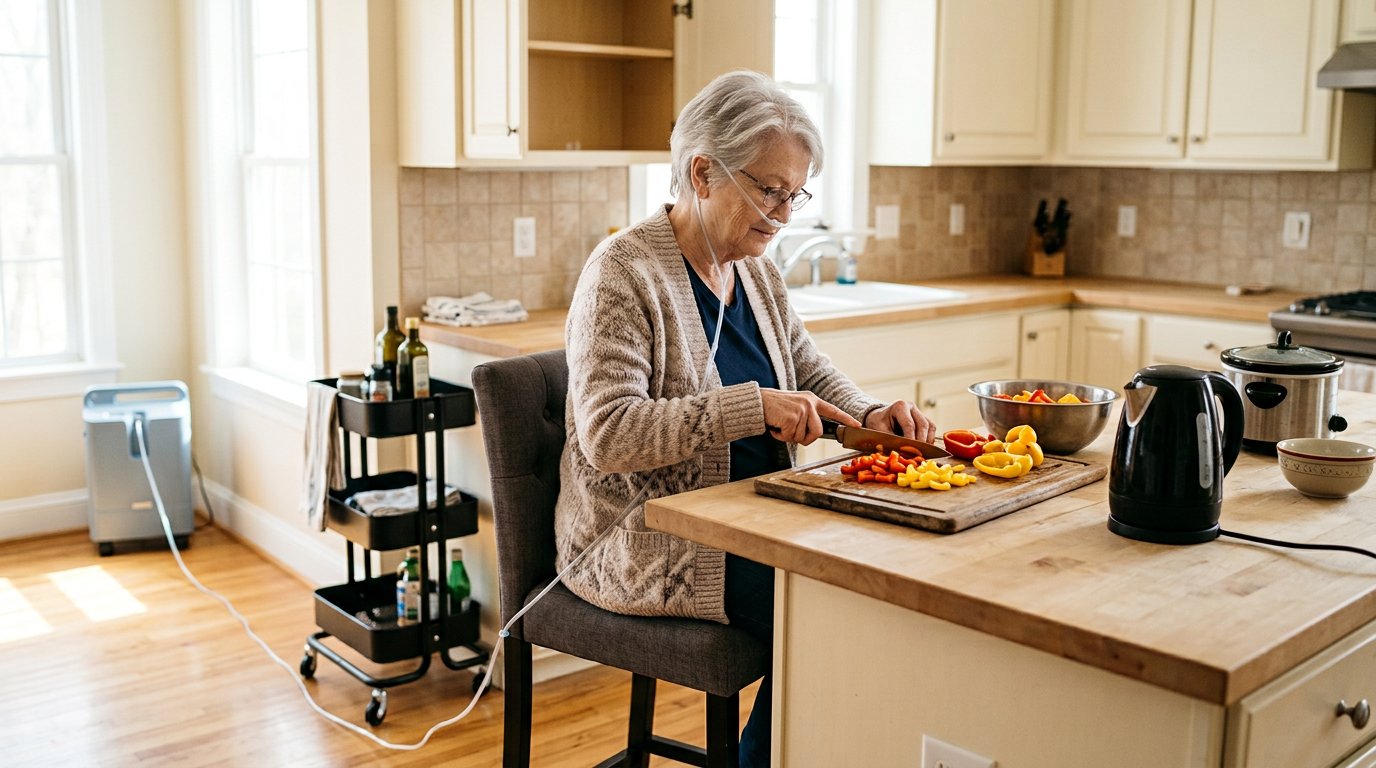
Cooking wears you out because raising your arms not walking is what traps air in your lungs. Fix the height of your kitchen, sit down for prep work, and cook in batches on your good days. Most people can rebuild their kitchen for under $150, and Medicare may send an occupational therapist to your house to help you do it.
The 4:30 PM Problem
There’s a moment I’ve heard described in almost the same words by dozens of people over the years.
It’s late afternoon. You’ve had an okay day. You go into the kitchen to make dinner. You reach up into the cabinet for the big pot — the heavy one on the second shelf — and by the time you get it down onto the stove, you have to stop and hold the counter and just breathe.
Dinner isn’t even started. And you’re done.
So you eat cereal. Or toast. Or nothing.
If that’s you, I want to tell you something up front: you are not weak, and you are not being lazy. What’s happening to you in that moment is a specific, measurable, physical event inside your chest. It has a name. And once you understand it, you can design your kitchen around it.
That’s what this guide is. Not a list of recipes. A blueprint for a room.
Why Reaching Up Steals Your Breath (The Part Nobody Explains)
Here’s the thing most COPD advice skips right past.
When you lift your arms above your shoulders, your chest muscles have two jobs at once. Those same muscles help you breathe — and now you’re also asking them to hold your arms up. They can’t do both well.
So your body does the only thing it can. It breathes faster instead of deeper.
And that’s the trap. When you breathe fast, you don’t get enough time to push the old air out before the next breath comes in. Air stacks up. Your lungs get more and more full of stale air that won’t leave.
Doctors call this dynamic hyperinflation. I call it the balloon that won’t empty.
Your lungs are already close to full. There’s no room left for a good deep breath. That’s the crushing feeling you get at the counter.
The research backs this up hard
This isn’t a theory. Researchers have measured it:
- Simply raising your arms — even with no weight in your hands — raises oxygen demand and breathing demand right away. And the demand keeps going for about two minutes after you put your arms back down. (Couser et al., Chest)
- Upper-body work causes more air trapping and more breathlessness than lower-body work does — at the exact same effort level. (Castagna et al., Respiratory Medicine)
- Everyday chores using the arms are enough on their own to trigger air trapping and shortness of breath. Researchers proved it with tasks as ordinary as moving pots onto a shelf. (Velloso et al.)
- A 2025 study found that people with COPD pull in their neck and chest muscles much harder than healthy people do during overhead tasks — and the worst task tested was putting a 4 kg object on a shelf at head height. (Canadian Respiratory Journal, 2025)
Read that last one again. A shelf at head height. That’s where your mixing bowl lives right now, isn’t it?
What this means for your kitchen
Most kitchen advice for COPD says “pace yourself” and “take breaks.” Fine. But it treats your kitchen as a fixed thing you have to survive.
It isn’t. Your kitchen is the problem. And a kitchen can be changed.
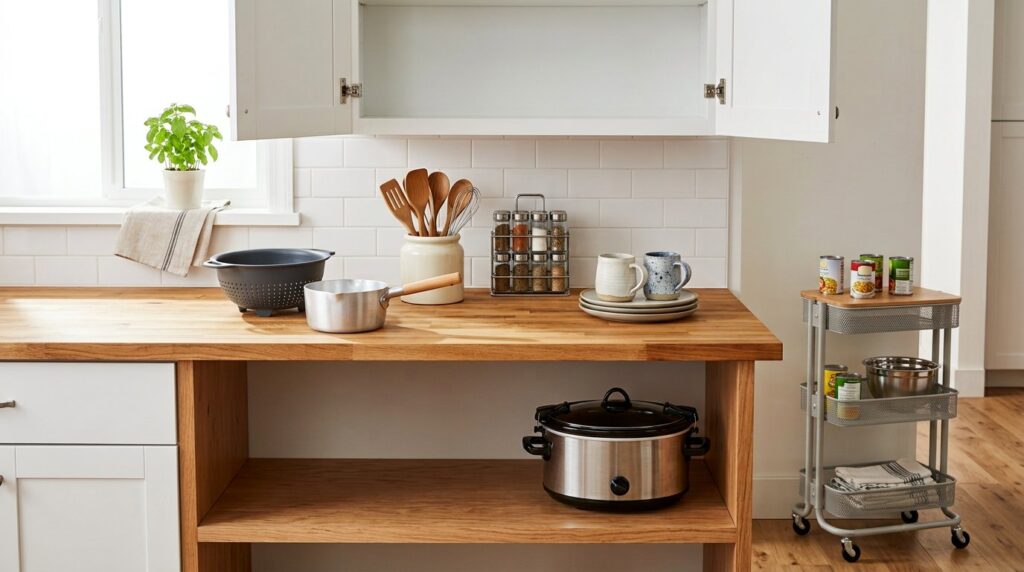
The single biggest win in this whole article: get everything you use out of the overhead cabinets and down between your hips and your shoulders.
Not because it’s tidier. Because every single overhead reach you delete is a small dose of air trapping you never have to recover from.
Step 1: Build Your “No-Reach Zone” (One Afternoon, About $0)
Here’s the rule: hip height to shoulder height. Nothing above. Nothing below.
That band is your no-reach zone. Everything you touch more than twice a week goes in it. Everything else can live wherever.
Don’t do this all at once. Do it in 15-minute pieces, sitting down, over a week.
The 10-item test
Don’t try to reorganize a whole kitchen. You’ll quit. Instead, for one week, put a sticky note on the counter and write down every item you actually reach for.
Most people find the real list is about 10 to 15 things:
- One pot, one pan
- A cutting board and one good knife
- Two or three plates, two bowls, a couple of mugs
- Silverware
- Coffee or tea supplies
- Salt, pepper, two or three spices
- Cooking oil
- The can opener
That’s it. That’s the list that has to be easy. Everything else in that kitchen is background noise you’re paying for in breath.
Where things go now
| Height | What lives there |
|---|---|
| Above shoulders | Holiday dishes. The big roasting pan. Things you touch twice a year — or nothing at all |
| Shoulder to hip (your zone) | Your 10–15 daily items. Countertop, open shelf, or first cabinet shelf only |
| Below hips | Heavy things you can slide out, never lift out — a stand mixer on a low shelf you pull forward |
Steal these tricks
- Leave your pots on the stove. Yes, on the burners. This is not messy; it’s medical equipment placement. The American Lung Association recommends exactly this. (American Lung Association)
- Hang a cheap tension rod across the back of the counter and hook your utensils on it. No drawer digging.
- Use a rolling cart — the $30 kind. Load it once. Roll it to where you’re working. Now you’ve made one trip instead of six.
- Buy doubles of cheap things. A second set of measuring spoons costs $4 and saves you a hundred trips across the room this year.
- Slide, never lift. Push the pot along the counter to the stove. Don’t carry it. A cheap plastic tray under heavy items turns lifting into sliding.
The bending rule: breathe out as you bend down, breathe in as you come back up. Never hold your breath during the hard part of a movement. (Royal Papworth NHS)
Step 2: Sit Down. Seriously.
Sitting instead of standing cuts your energy use by roughly 25%. (St. Joseph’s Healthcare Hamilton)
A quarter of your energy, back. For free. Just by putting a chair somewhere.
Most people don’t do this for one reason: standard kitchen counters are 36 inches high, and a dining chair puts you far too low. You end up hunched and reaching up — which is the exact thing we’re trying to avoid.
Two ways to fix it
Option A — the perching stool. A tall stool, 24 to 30 inches, with a back if you can get one. This puts your elbows at counter level with your feet on the floor or a rung. Around $40–$120. This is the better fix.
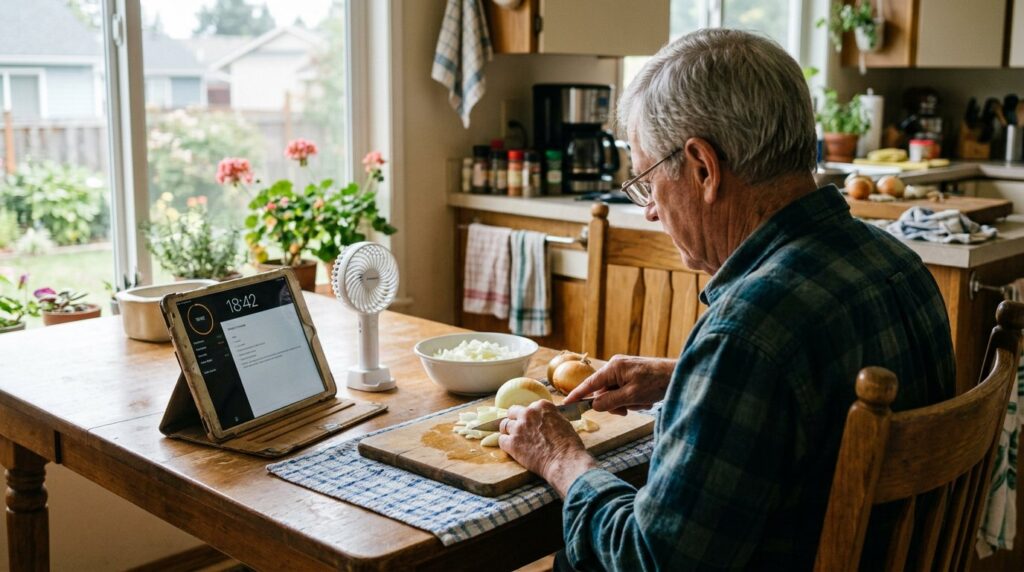
Option B — move the work to the table. Cheaper and it works. Bring the cutting board to the dining table and prep sitting in a normal chair. You’ve lost nothing except a few steps.
How to sit so it actually helps
Sitting badly wastes the benefit. Do this instead:
- Rest your elbows on the surface. This “props” your rib cage and takes load off the muscles you breathe with. This is the same trick as the tripod position people use during a flare — it works while chopping too.
- Sit up tall. Don’t slump forward over your belly. A slumped belly pushes up on the diaphragm and makes breathing harder.
- Drop your shoulders. Check them every couple of minutes. If they’ve crept up toward your ears, you’re using neck muscles to breathe.
- Feet flat and supported. Dangling legs make you tense your core, which costs you air.
Tasks that should never be done standing
Chopping. Peeling. Mixing. Measuring. Rolling. Washing dishes. Loading the dishwasher. Waiting for water to boil.
If it takes more than about 30 seconds and doesn’t require you to be at the stove, do it sitting.
Step 3: Cook Once, Eat Four Times
You do not have to cook every day. Let go of that.
Good days and bad days aren’t random noise — they’re a resource. On a good day you have surplus energy. Spend it buying yourself easy days later.
The good-day trade
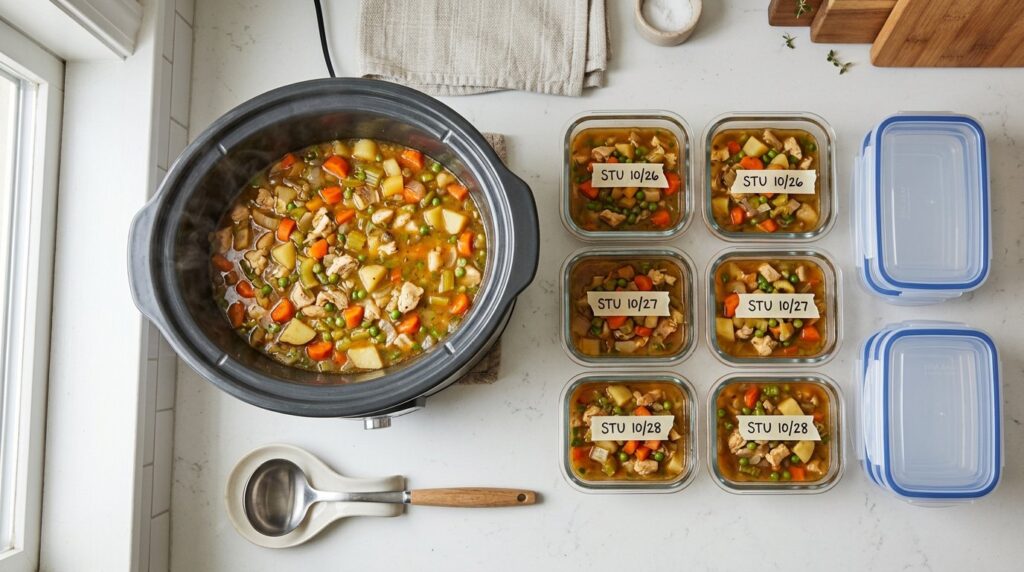
When you feel decent, don’t make one dinner. Make four. Portion it. Freeze it. Now three future bad days are already handled.
You spent one hour to buy back three hours on the days you’ll have nothing left to spend.
Make your machines do the standing
- Slow cooker. Load it sitting down in the morning, when energy is usually highest. Walk away. It cooks with zero supervision, no standing, no stirring, no steam in your face.
- Microwave. Underrated. No open flame — which matters a great deal if you’re on oxygen (more on that below).
- Sheet pan meals. Everything on one pan, into the oven, done. One pan to wash.
- Electric kettle. Lighter than lifting a full pot of water. Fill it with a small jug rather than carrying the whole thing to the tap.
- Dishwasher. If you have one, use it for everything. If you don’t: soak the dishes, then air-dry on a rack. Never stand there towel-drying dishes.
Shop like it’s a strategy
- Buy pre-cut vegetables and pre-cooked protein. Yes, they cost more. Compare that to the cost of not eating.
- Rotisserie chicken is three or four meals with zero prep.
- Frozen vegetables are already washed and chopped, and nutritionally they hold up fine.
- Grocery delivery removes the single most exhausting part of eating — the store.
- If money’s tight, look up Meals on Wheels in your area. It’s a real program and people who qualify often don’t realize it.
Timing beats effort
Cook when you’re strongest, not when it’s traditional dinnertime.
For most people the best window is mid-morning, after inhalers have kicked in and before afternoon fatigue arrives. If your best hour is 10 AM, cook dinner at 10 AM and reheat it later. There is no rule that says dinner must be made at 5 PM.
Step 4: The Air You’re Cooking In
Here’s a gap in nearly every COPD kitchen article I’ve read. They’ll tell you where to put the stool. They won’t tell you what’s coming out of your stove.
If you cook on gas, your stove is an unvented combustion appliance sitting in your house. It produces nitrogen dioxide (NO₂) — a gas that irritates airways and is directly linked to worse outcomes in COPD.
The numbers are worse than most people expect:
- In a controlled test, kitchen NO₂ went from a background of 18 ppb up to 197 ppb during gas cooking. In homes with induction, it barely moved. (Columbia Mailman School of Public Health)
- Swapping gas for induction cut average daily NO₂ by 56%.
- In a Stanford-led study, NO₂ in bedrooms — not even the kitchen — passed WHO health guidelines within 25 minutes of oven use in half the homes tested. In two homes it stayed high for two to three hours after the oven was off. (Kashtan et al., Science Advances, 2024)
- Range hoods help, but less than you’d hope: real-world hoods cut kitchen NO₂ by only 10–70% (average 35%).
What to actually do about it
You probably can’t replace your stove this week. Fine. Do these instead:
- Turn the hood on every single time. Before you light the burner, not after. Leave it running 10–15 minutes after you finish.
- Use the back burners. Hoods capture back-burner emissions far better than front. This costs you nothing and helps a lot.
- Crack a window while cooking, even a couple of inches, even in winter.
- Check if your hood actually vents outside. Many don’t — especially the microwave-over-the-range type. If it just blows air back into the room, it does almost nothing for NO₂. Hold a tissue up to it; if it’s recirculating, treat it as a filter, not a vent.
- A $60 portable induction burner or a countertop appliance covers most weekday cooking with zero combustion. This is the highest-value small purchase in this entire article.
- Skip aerosol sprays in the kitchen. Cooking sprays, air fresheners, harsh cleaners — all common triggers.
- Manage steam. Open lids away from your face. Lean back. A face-full of hot steam can set off a spasm of breathlessness in seconds.
Step 5: If You Use Oxygen, Read This Twice
This section is not optional, and it’s the section most gentle lifestyle articles tiptoe around. I won’t.
Oxygen does not explode. It does something arguably worse — it makes everything around it burn faster, hotter, and more easily.
Oxygen soaks into fabric, hair, and skin. In an oxygen-rich pocket of air, a small flame becomes a large one instantly. The most common serious injuries are burns to the face and airway, from the cannula itself igniting.
The rules
- Never cook over an open gas flame while wearing a nasal cannula. Not “carefully.” Not “leaning back.” No.
- Keep oxygen equipment and tubing at least 5 feet from any flame or heat source — many providers recommend 10. (National Council on Aging)
- Keep the concentrator or tank out of the kitchen entirely while you’re cooking. (Michigan Medicine Home Care)
- Route the tubing away from the stove, along walls, never under rugs or across the floor where you’ll trip.
- No petroleum-based lotions or lip balm. Water-based only.
- Never use aerosols near flowing oxygen.
- Working smoke alarms. A fire extinguisher within reach. Test both.
The honest workaround
If you’re on oxygen and you have a gas stove, the realistic answer is: stop using the gas burners.
Use a microwave, a slow cooker, an electric pressure cooker, or a plug-in induction burner instead. These cover the overwhelming majority of home cooking with no open flame.
If you must cook with a flame — take the cannula off, if and only if your care team has told you it’s safe for you to be off oxygen for that long. Ask them first. Never guess about this, and never adjust your flow rate on your own.
Step 6: Breathe on Purpose While You Work
Two techniques. Both free. Both worth learning properly.
Pursed-lip breathing
- Breathe in through your nose for about 2 seconds. Mouth closed.
- Purse your lips like you’re about to blow out a candle.
- Breathe out slowly through pursed lips for 4 to 6 seconds — two to three times as long as you breathed in.
The long exhale keeps your airways propped open longer, so more stale air gets out. That’s the direct antidote to the air-trapping problem we started with. (Royal Papworth NHS)
Match your breath to your movement
This is the pro-level habit, and it’s the one that separates people who cope well from people who struggle:
Breathe IN before you start. Breathe OUT during the hard part.
Lifting the pot? Exhale as you lift. Bending to the low shelf? Exhale on the way down. Standing up from the stool? Exhale as you rise.
Most people instinctively hold their breath during effort. That’s precisely backwards, and it’s the thing that turns a small task into a two-minute recovery.
The handheld fan
A cheap battery fan, held so it blows on your face, genuinely reduces the sensation of breathlessness. It’s a standard recommendation in UK pulmonary rehab and it costs about $10. Keep one on the counter.
Step 7: Eating Without Getting Winded
You went to all this trouble to make food. Now the meal itself makes you breathless.
That’s real, and it has a mechanical cause: a full stomach pushes up against a diaphragm that’s already flattened by hyperinflated lungs. Less room to breathe.
What helps:
- Eat 5 or 6 small meals instead of 3 big ones. Smaller stomach, more room for lungs.
- Rest for 30 minutes before eating. Don’t cook and then immediately eat — you’ll be too breathless to finish.
- Sit upright, elbows on the table, feet on the floor. Best lung expansion. (COPD Foundation)
- Eat the high-calorie, high-protein part first, in case you tire before you finish.
- Drink between meals, not during. Fluid takes up stomach room you need for food.
- Go easy on gas-producing foods — carbonated drinks, beans, cabbage, broccoli, onions. Bloating pushes on the diaphragm.
- Don’t lie down right after eating. Rest sitting up.
- If you’re on continuous oxygen, ask your provider whether you should be on it while eating. Chewing and swallowing use oxygen. Don’t change the setting yourself.
The part that’s actually dangerous
This is the hidden risk in the whole “too tired to cook” problem, and it’s why this article isn’t really about convenience.
When cooking is exhausting, people skip meals. Skipped meals become weight loss. Weight loss in COPD becomes muscle loss — including in the muscles you breathe with.
The data is blunt:
- Malnutrition affects roughly 20–22% of people with stable COPD, and it rises sharply with more severe breathlessness. (Hoong et al., Int J COPD)
- During a hospitalization for a flare-up, 48% had sarcopenia (muscle loss) and 52% were malnourished. One-year survival was 65% in those with sarcopenia versus 86% without. (European Journal of Clinical Nutrition, 2020)
- In U.S. NHANES data, COPD patients with sarcopenia had a 44% higher risk of death from any cause. (Frontiers in Nutrition, 2024)
So: a stool and a slow cooker are not lifestyle upgrades. Making it physically possible to keep eating is part of your treatment.
If you are losing weight without trying, tell your doctor. Ask for a referral to a registered dietitian. This is a medical issue, not a willpower issue.
The Part Almost Nobody Tells You: Insurance May Pay for This
Here’s what routinely gets left out of COPD kitchen articles — the money and the professional help.
Occupational therapy in your own kitchen
An occupational therapist (OT) is the specialist for exactly this problem. They come to your home, watch you cook, and tell you what to change. Not generic tips — your counter, your cabinets.
Under Medicare’s home health benefit, if you meet the criteria — you’re homebound, your doctor orders it, and you use a Medicare-certified agency — covered home health visits are typically $0 out of pocket. (Medicare.gov)
Two things people don’t know:
- You don’t have to be “getting better” to qualify. Under the Jimmo v. Sebelius settlement, skilled care to maintain your condition or slow decline is covered. “Chronic and stable” is not a valid denial reason for a progressive condition like COPD.
- Durable medical equipment is covered at 80% after your Part B deductible, if prescribed as medically necessary.
Ask your doctor this exact sentence: “Can you order a home health occupational therapy evaluation for energy conservation and kitchen safety?”
Pulmonary rehabilitation
If you’re not enrolled, this is the highest-value thing you can do for breathlessness, full stop. Medicare Part B covers pulmonary rehab for qualifying patients. Many programs include energy-conservation training for daily tasks. Ask for a referral.
Other funding worth checking
- Medicare Advantage plans increasingly offer supplemental benefits for chronically ill members — sometimes a yearly allowance for home modifications. Call the number on your card and ask about “supplemental benefits for chronically ill beneficiaries.”
- Medicaid HCBS waivers vary by state but often cover home modifications and equipment.
- Area Agency on Aging — call your local office. They know local programs no website lists.
- VA benefits — if you’re a veteran, home improvement grants and prosthetics-program equipment can cover a surprising amount.
Your Budget Blueprint
Because “get a perching stool” isn’t useful without knowing what things cost.
Free (do these today)
- Move your 10–15 daily items into the hip-to-shoulder zone
- Leave pots on the stove
- Prep sitting at the dining table
- Turn the range hood on before you light a burner
- Use the back burners
- Start breathing out on the hard part of every movement
Under $50
- Handheld fan (~$10)
- Second set of measuring spoons and utensils (~$10)
- Tension rod and hooks (~$15)
- Non-slip mat under the cutting board (~$10)
- Jug for filling the kettle (~$8)
- Long-handled reacher/grabber (~$20)
$50–$200 (highest impact)
- Rolling three-tier cart (~$30–60)
- Perching stool with back (~$40–120)
- Portable induction burner (~$60–100)
- Slow cooker or electric pressure cooker (~$40–90)
- Lightweight aluminum pans replacing cast iron (~$40)
- Electric can opener (~$25)
Ask about coverage instead of paying
- OT home evaluation — potentially $0 through home health
- Pulmonary rehab — Medicare Part B
- Some DME — 80% covered with a prescription
Your First Week (Don’t Do It All)
If you try to redo the kitchen in one afternoon, you’ll trigger a flare and quit. Do this instead.
Day 1 — Sit down. Write your list of 10–15 daily items. That’s the whole task.
Day 2 — Move those items into the hip-to-shoulder zone. 15 minutes only. Stop when the timer goes off, even if you’re not done.
Day 3 — Set up one seated prep station. Chair at the table, board, knife, non-slip mat.
Day 4 — Practice pursed-lip breathing while doing one small task. Practice breathing out on the hard part.
Day 5 — Call your doctor’s office. Ask for the OT evaluation and about pulmonary rehab.
Day 6 — Do one batch cook. One slow cooker meal, portioned into four containers, frozen.
Day 7 — Rest. Notice what still made you breathless, and write it down. That’s your next fix.
Questions People Actually Ask
Why does cooking make me more breathless than walking?
Because of your arms. Raising them above shoulder height forces your chest muscles to do two jobs at once, so you breathe faster instead of deeper and stale air stacks up in your lungs. Research has shown upper-body tasks cause more air trapping and breathlessness than lower-body tasks at the same effort level.
Can I use a gas stove if I’m on oxygen?
No — not while wearing your cannula. Oxygen makes fires start easier and burn hotter, and cannula fires cause serious facial burns. Keep equipment 5–10 feet from flames, and use a microwave, slow cooker, or induction burner instead. Ask your care team before ever removing your oxygen.
Does sitting down really make a difference?
Yes — around 25% less energy used than standing. Prop your elbows on the surface, sit tall, keep your shoulders down and your feet supported.
Will Medicare pay for someone to help me set up my kitchen?
Often, yes. A home health occupational therapy evaluation may be $0 out of pocket if you’re homebound, your doctor orders it, and you use a Medicare-certified agency. You do not need to be improving to qualify.
Is a gas stove actually bad for my COPD?
It’s a real exposure worth managing. Gas cooking pushes indoor NO₂ far above health guidelines, and NO₂ irritates airways. Always vent, use back burners, crack a window, and consider a plug-in induction burner for daily cooking.
What should I do on days I truly can’t cook at all?
Have a plan ready before you need it: frozen portions from a good day, shelf-stable backups, Meals on Wheels, or delivery. Not eating is the worst option, because weight and muscle loss make breathing harder and are linked to worse outcomes.
How many meals a day should I eat?
Five or six small ones instead of three large. A full stomach presses on your diaphragm. Rest 30 minutes before eating and sit upright with elbows on the table.
The Real Point
Everything here comes down to one idea.
Stop trying to be tougher than your lungs. Start making the room easier.
Lowering a shelf isn’t giving up. Sitting to chop isn’t giving up. Buying pre-cut onions isn’t giving up.
It’s the opposite. Every bit of breath you don’t burn reaching into a cabinet is breath you get to spend somewhere that matters — a phone call with your grandkids, a walk to the mailbox, actually finishing dinner.
Start with one shelf. That’s all. Just one.
⚕️ Medical Disclaimer
This article is for general education only. It is not medical advice, and it does not replace care from your own doctor, respiratory therapist, occupational therapist, or dietitian.
COPD varies enormously from person to person. What works for one person may be unsafe for another. Always talk to your own care team before changing anything about your oxygen use, medications, diet, or activity level.
Specifically:
- Never change your oxygen flow rate on your own.
- Never remove supplemental oxygen without guidance from your prescriber.
- If you have new or worsening breathlessness, chest pain, confusion, blue lips or fingertips, or a fever with increased mucus, seek medical care immediately. In an emergency in the U.S., call 911.
Product examples are illustrative only. We do not endorse specific brands, and nothing here is a promise of results or of insurance coverage. Coverage rules change and vary by plan — verify with Medicare or your insurer directly.
About the Author
Reviewed for clinical accuracy; the reviewer is not responsible for editorial or commercial content on this page.
References
- Couser JI, Martinez FJ, Celli BR. Pulmonary rehabilitation that includes arm exercise reduces metabolic and ventilatory requirements for simple arm elevation. Chest. — https://pubmed.ncbi.nlm.nih.gov/1424897/
- Castagna O, et al. Exercises using the upper limbs hyperinflate COPD patients more than exercises using the lower limbs at the same metabolic demand. Monaldi Arch Chest Dis / Respiratory Medicine. — https://pubmed.ncbi.nlm.nih.gov/19522161/
- Velloso M, et al. Daily activities are sufficient to induce dynamic pulmonary hyperinflation and dyspnea in COPD patients. Clinics. — https://pmc.ncbi.nlm.nih.gov/articles/PMC3317254/
- Association Between Muscle Activity of Upper Limbs and Respiratory Parameters During Functional Performance in People With COPD. Canadian Respiratory Journal, 2025. — https://pmc.ncbi.nlm.nih.gov/articles/PMC11961279/
- American Lung Association. Conserving Energy and Managing Your Daily Activities. — https://www.lung.org/lung-health-diseases/lung-disease-lookup/copd/living-with-copd/daily-activities
- COPD Foundation. Energy Conservation Techniques in Pulmonary Rehabilitation. — https://www.copdfoundation.org/COPD360social/Community/COPD-Digest/Article/2337/Energy-Conservation-Techniques-in-Pulmonary-Rehabilitation.aspx
- COPD Foundation. Nutrition for Someone with COPD. — https://www.copdfoundation.org/Learn-More/I-am-a-Person-with-COPD/Nutrition-for-Someone-with-COPD.aspx
- Royal Papworth Hospital NHS Foundation Trust. Energy Conservation: Coping with Everyday Activities. — https://royalpapworth.nhs.uk/application/files/3215/8590/5483/PI_179_Energy_Conservation_A4_v2.pdf
- St. Joseph’s Healthcare Hamilton. Energy Conservation (PD 8278). — https://www.stjoes.ca/patients-visitors/patient-education/a-e/PD%208278%20Energy%20Conservation.pdf
- Kashtan Y, et al. Nitrogen dioxide exposure, health outcomes, and associated demographic disparities due to gas and propane combustion by U.S. stoves. Science Advances, 2024. — https://www.science.org/doi/10.1126/sciadv.adm8680
- Columbia University Mailman School of Public Health. Switching from Gas to Electric Stoves Cuts Indoor Air Pollution, 2024. — https://www.publichealth.columbia.edu/news/switching-gas-electric-stoves-cuts-indoor-air-pollution
- National Council on Aging. How to Use Home Oxygen Safely. — https://www.ncoa.org/article/safety-tips-for-using-supplemental-oxygen/
- Michigan Medicine Home Care Services. Use Medical Oxygen Safely at Home. — https://homecare.med.umich.edu/Content/Documents/HomeCare/FirePreventionInfographic.pdf
- Hoong JM, et al. Prevalence of malnutrition in COPD and its relationship with the parameters related to disease severity. Int J Chron Obstruct Pulmon Dis. — https://pmc.ncbi.nlm.nih.gov/articles/PMC6188194/
- Prevalence of sarcopenia and malnutrition during acute exacerbation of COPD and after 6 months recovery. Eur J Clin Nutr, 2020. — https://www.nature.com/articles/s41430-020-0623-6
- Association of dietary inflammatory indices with sarcopenia and all-cause mortality in COPD patients. Frontiers in Nutrition, 2024. — https://www.frontiersin.org/journals/nutrition/articles/10.3389/fnut.2024.1395170/full
- CDC. About COPD. — https://www.cdc.gov/copd/about/index.html
- Medicare.gov. Home Health Services Coverage. — https://www.medicare.gov/coverage/home-health-services